
Day 210: The Power of the Weak

1 Chronicles 22-24; Acts 23

Key Verses

1 Chronicles 22:10
“[Solomon] shall build a house for my name. He shall be my son, and I will be his father, and I will establish his royal throne in Israel forever.”

Acts 23:1
And looking intently at the council, Paul said, “Brothers, I have lived my life before God in all good conscience up to this day.”

Today we read the beginning of the end of 1 Chronicles. David has brought the ark to Jerusalem, subdued his enemies and purchased the land for a permanent temple. The rest of the book will now detail all of the preparations David made for the building of and worship within the new temple.

David’s devoted preparations for the temple are reminiscent of Moses preparing the people to enter the promised land. Neither David nor Moses would live to see the fulfillment of their work, and they were both commanded to raise up a younger leader to finish what they had began…For Moses, it was Joshua who led the people across the Jordan into the promised land. And here we read of David commissioning his son, Solomon, by reiterating the covenant promises of God (1 Chronicles 22:10).

The Davidic covenant would not be fulfilled in the expected way. Under Solomon’s reign, Israel would reach the heights of power, prosperity, and peace. Human wisdom would suggest that Solomon was the fulfillment of God’s promise to establish his kingdom on earth. But history tells us that Solomon’s sin brought dissension to Israel culminating in the destruction of the temple and the nation. God’s promise was fulfilled hundreds of years later through a Divine baby born in poverty. It is so often that we expect God to fulfill His will through pomp and power – yet he surprises us by working through the weak and lowly.

As I read Acts 23, again I marvel at God’s ways… From this point until the end of Acts, Paul would be a prisoner. Human logic would propose that God could accomplish more through a “free” Paul than an “imprisoned’ Paul…

Consider this… Solomon and Joshua would have never risen to be two of the most effective leaders in biblical history if Moses and David were still in the picture. Paul’s imprisonment gave room for other leaders to emerge. The spread of the gospel didn’t stop because Paul was imprisoned. Rather, God used Paul’s imprisonment to stir the passion of the early church – and God raised up others to multiply Paul’s work among the churches.

This is the fingerprint of God… His modus operandi… He breathes power into the weak and lowly to accomplish His Great work in the world. He turns the impossible into possible. And in so doing, He receives the glory!
Day 208: A Far-Reaching Gospel

1 Chronicles 17-19; Acts 22

Key Verses

1 Chronicles 17:11-14
“‘When your days are fulfilled to walk with your fathers, I will raise up your offspring after you, one of your own sons, and I will establish his kingdom. He shall build a house for me, and I will establish his throne forever. I will be to him a father, and he shall be to me a son. I will not take my steadfast love from him, as I took it from him who was before you, but I will confirm him in my house and in my kingdom forever, and his throne shall be established forever.'”

God’s house and an Eternal dynasty… The Davidic Covenant (found in today’s Key Verses) is God’s promise to David that his son would build God a house and that God would establish David’s throne forever…

These two promises – of a House and a forever King – became Israel’s hope and identity. To the (kingless) people in the post-exilic Jerusalem, the Davidic covenant pointed to their future hope for a Messiah.

For us, we can look to the kingdom under Solomon’s reign as a precursor of God’s eternal Kingdom on earth. The prosperity and peace of Israel haven’t been matched since the days of Solomon!

The Davidic Covenant joins the Abrahamic and Mosaic Covenants in describing God’s relationship with His people. The Abrahamic and Davidic Covenants promised to make a Great Nation. The Mosaic Covenant laid the foundation for how to live and worship in this nation.

The Mosaic law was a conditional covenant… if the people obeyed, they would be blessed. If they disobeyed, they would be cursed. But the Abrahamic and Davidic Covenants were based on God’s loving kindness; they were not conditional on the obedience of the people.

Of all three Covenants, the promises made to Abraham give the broadest picture of God’s relationship with His people… God promised to bless all the nations of the earth through Abraham and his family. David’s Covenant refines this promise to reveal how the nations would be blessed – through the Eternal King that would come from the line of David.

Somehow, the Jews of Paul’s day missed these points in the Great Promises.

Remember the context for today’s reading from Acts? Paul had just been arrested by the Roman Tribune to save him from the rioting crowd in Jerusalem. As Paul was being led to the barracks, he asked permission to speak to the crowds. Acts 22 records his testimony to the Jewish people.

The people listened as Paul spoke in the Hebrew language and defended his Jewish heritage. The people listened further as Paul described his encounter with Jesus – his “Damascus Road” experience – but they stopped listening when Paul reported that this Jesus had commanded him to go to the Gentiles. At this, the people became enraged, “shouting and throwing off their cloaks and flinging dust into the air!”

The people had lost sight of the Abrahamic Covenant – the promise of which all the peoples of the earth would be blessed… And they had forgotten that David’s seed was the conduit for the blessing!

The pride that came from adhering to the strict moral demands of the Mosaic Law blinded the people to God’s love for all the nations. They misunderstood when Jesus spent time with “sinners” and died a criminal’s death. And they rioted against Paul at the mere mention of those wretched, lawless Gentiles.

We are tempted by the same pride. We can’t let the trap of moral superiority prevent us from taking the gospel to all people! There are no prerequisites for the gospel. It crosses every line – race, gender, nation, and tongue. Jesus came to bless all the peoples of the earth – even wretched, lawless people like us.

Day 207: Celebrating God’s Presence

1 Chronicles 14-16; Acts 21:15-40

Key Verses

1 Chronicles 16:8-11
Oh give thanks to the Lord; call upon his name;
make known his deeds among the peoples!
Sing to him, sing praises to him;
tell of all his wondrous works!
Glory in his holy name;
let the hearts of those who seek the Lord rejoice!
Seek the Lord and his strength;
seek his presence continually!

Jerusalem. It is the backdrop for our reading today…

In 1 Chronicles, David had just captured Jerusalem and made it his home, and from that point forward, it would be known as “The City of David.” We read as David brings the ark into the city (this time, being careful to obey the Mosaic laws concerning carrying the ark!)

The “chronicler” describes a joyous celebration as the people praise and worship the Lord. It was a new beginning. A newly unified people being led by a godly leader.

It’s important to remember the original audience of 1 Chronicles… The “chronicler” was writing to encourage the post-exilic community. But consider the great differences between these two communities – both living in Jerusalem – during different points in their history.

David’s Israel was beginning anew and experienced a youthful joy. Unlike the post-exilic community, they hadn’t experienced the fullness of God’s judgment…yet. The post-exilic community was in the unique position of experiencing both God’s full judgment AND the beginnings of the promised restoration. The “chronicler” wanted to encourage them to celebrate their restoration with the joy exemplified by David and his Psalms. But their history also instructed them that observance of the Mosaic law was linked to blessing. Obedience was the road to further restoration. Obedience was where the former Israel failed. The restored Israel must hold the law closely. They must observe the law. They must.

In Acts, we see how this mindset had grown into a strict, legalistic observance of the Mosaic law. This legalistic mindset prevented the Jewish believers from totally accepting grace as the only means of salvation. The elders and apostles in Jerusalem accepted the theology of grace, but the new Jewish convert struggled to let go of the old traditions and rituals.

So the Jews in Jerusalem lashed out against Paul… This city who had witnessed the dancing of David and rose out of the ashes to welcome the exiles. This blessed city – killed the promised Messiah and attacked Paul with such passion that the Roman tribune had to arrest Paul to save him from the rioting crowd!

O Jerusalem, Jerusalem, the city that kills the prophets and stones those who are sent to it! How often would I have gathered your children together as a hen gathers her brood under her wings, and you were not willing! (Matthew 23:37)

The people of Jerusalem needed to look at David more closely. He celebrated the ark’s return to Jerusalem because it symbolized the return of God’s presence. He respected God’s law and he rejoiced in His provision and grace!

We must not overlook this lesson! We must not fall into a life of legalism and in so doing belittle the grace of God! If David celebrated the mere symbol of God’s presence, what should we do as Christians who have the very Spirit of God living inside us??

God dwells among us. We should celebrate!

Day 206: A Costly Misstep

1 Chronicles 12-13; Acts 21:1-14

Key Verses

1 Chronicles 13:7-8
And they carried the ark of God on a new cart, from the house of Abinadab, and Uzzah and Ahio were driving the cart. And David and all Israel were celebrating before God with all their might, with song and lyres and harps and tambourines and cymbals and trumpets.

Acts 21:13
Then Paul answered, “What are you doing, weeping and breaking my heart? For I am ready not only to be imprisoned but even to die in Jerusalem for the name of the Lord Jesus.”

Chapter 13 begins the saga of returning the ark to Jerusalem. This act was significant because all Israel agreed to it (continuing the theme from chapters 10-12 of David unifying the nation), and it was an act of spiritual renewal. By bringing the symbol of God’s holy presence back into the assembly of the people, David was acting as both their military and spiritual leader.

The idea was great, but, unfortunately, the execution was poor… David did not ensure the ark was carried according to Mosaic law – that is – carried by the Levites via poles. Instead the ark was transported on a cart – similarly to the way the Philistines transported the ark when it was in their possession.

This was a costly oversight. When the oxen stumbled and the layman, Uzzah, reached out his hand to protect the ark, Uzzah was killed instantly by God.

This has always been a difficult passage for me. Why would God execute such severe judgment for an unintentional breach of the law when it seems He offers grace for far worse offenses? This is a difficult question, but looking at the context for this and other similar instances can shed some light…

God acted in a similar fashion with Aaron’s sons (Leviticus 10) and against Ananias and Sapphira (Acts 5). In both cases, God was in the process of establishing His people.

  • In the case of Aaron’s sons, the tabernacle had just been built, and Aaron’s first sacrifice had just been accepted. On the same day, his sons “offered unauthorized fire before the Lord” and they were killed instantly. God would not let the impure actions of Aaron’s sons pollute the sacrificial system that had just been established.
  • In the case of Ananias and Sapphira, the church was in its infant stages. The Holy Spirit was working mightily among the people, and God would not tolerate the lies of this couple polluting his earliest congregation.

Similarly, the context of Uzzah’s death was during an essential “establishment period.” David was bringing the ark into his city to be the centerpiece of worship, attempting to unify the people around the Mosaic law. God would not tolerate impurity. Especially not in the beginning stages of re-establishing His people under the rule of David.

Finding a pattern to make sense of God’s actions might be helpful, but I think the bigger issue lies within my own heart. When I react to God’s actions in a toddler-type fashion, (i.e. “That’s not fair!”), I know that my perspective is askew. God has every right in his holiness to kill any of us in our sinfulness at any time. But because he is gracious and doesn’t do it very often, I can slip into an attitude of entitlement.

I need to be more like Paul… His perspective is more in line with reality. He knew he had no claim on his life (Acts 21:13)…that his life belonged totally to Jesus. Why has God granted us the privilege of life? To bring him glory in all that we do! Our lives were bought with the precious blood of the Lamb. Who am I to clutch my life tightly as if it were mine to lose? The Lord gives and the Lord takes away. Blessed be the name of the Lord.

Day 205: His Strength in Our Weakness

1 Chronicles 10-11; Acts 20:17-38

Key Verses

1 Chronicles 10:14
[Saul] did not seek guidance from the Lord. Therefore the Lord put him to death and turned the kingdom over to David the son of Jesse.

1 Chronicles 11:9
And David became greater and greater, for the Lord of hosts was with him.

Acts 20:24
But I do not account my life of any value nor as precious to myself, if only I may finish my course and the ministry that I received from the Lord Jesus, to testify to the gospel of the grace of God.

Today we read one of my favorite sections of Acts, Paul’s farewell speech to the Ephesian elders.

Not only is Paul’s speech thick with theology, but it is also heavy with emotion, giving us a glimpse of the impact Paul’s pastoral care had on the church.

Also noteworthy is Paul’s commitment to obeying the Lord no matter the personal cost. Paul’s whole-hearted devotion is uncomfortably challenging to me! But the reading in 1 Chronicles reminds me of an encouraging truth…

God was not with Saul, and he failed…miserably. Whereas God was with David, and even though he lived through great hardship on his road to the throne (all of which is omitted from 1 Chronicles), he was empowered by God to not just endure the hardship – but to overcome it.

Paul’s deep commitment to his call did not come from something inside himself. He didn’t muster up that sort of faith through self-will. No! He was empowered by the Spirit.

So are we! As I am convicted of a lack of devotion and feeling feeble in my faith, I realize that this is exactly the way I should feel, because I am weak. I know that if I confess my weakness to God – he will meet me there and empower me to meet life’s challenges.

This is the way of the gospel. God has resurrection power – the power to bring life out of death. This is the same power he uses to bring strength out of weakness. His grace is sufficient. It always is!

Day 204: Genealogy and Deathly long sermons

1 Chronicles 7-9; Acts 20:1-16

Key Verses

1 Chronicles 9:1
So all Israel was recorded in genealogies, and these are written in the Book of the Kings of Israel. And Judah was taken into exile in Babylon because of their breach of faith.

Acts 20:9-10
And a young man named Eutychus, sitting at the window, sank into a deep sleep as Paul talked still longer. And being overcome by sleep, he fell down from the third story and was taken up dead. But Paul went down and bent over him, and taking him in his arms, said, “Do not be alarmed, for his life is in him.”

The long genealogy of Israel ends in today’s reading from 1 Chronicles. The “Chronicler” has framed Israel’s entire history in the context of genealogical lists!

Remember, the Chronicler lived in post-exile Jerusalem and wanted to remind the people of their history and heritage. The structure* of these nine chapters reveals his purposes…

  • He covers Judah first… the royal tribe, the lineage of King David, and the main tribe of the southern kingdom.
  • He ends with Benjamin, using the tribes of the southern kingdom to bracket* the other tribes.
  • In the very center, or heart* of the genealogies, is the Levite tribe – representing the spiritual heart of the nation.
  • The inclusion of the northern tribes affirms that God considered all of Israel his chosen people – and there were some from the northern tribes living in the post-exile Jerusalem.

If you drill down into each tribe’s genealogies, they were strategically structured to remind the people of their heritage. He recounted how both the northern and southern tribes “broke faith” with God (1 Chronicles 5:25-26, 1 Chronicles 9:1, respectively). Since they were on the other side of judgment, he was trying to point to God’s grace of restoration – so that they might order their lives around the law of God and experience a more full restoration.*

If the detailed genealogies in 1 Chronicles aren’t enough, we are inundated with even more details, as we read about Paul’s travels in Acts. Sandwiched between these details, however, is a humorous story of Paul boring a young man to sleep with his “prolonged speech.” And then, as Paul “talked still longer,” the man was sleeping so soundly that he fell from the third story window and died! Thankfully, Paul was given the power to revive him. This “interruption” was no deterrent to Paul who kept talking until daybreak.

Hidden in the humor of this story is a glimpse of Paul’s character… He was wholly devoted to his mission to teach the gospel. Nothing would distract him – not even the death of a bored seeker!

Think of how easily we are distracted by both the pleasures and plights of this world. We must not be distracted! We must keep our eyes fully focused on His word and work in this world!!

*ideas or words with an asterisk (*) came from the study notes of the ESV Study Bible (Crossway).

Day 203: Genealogy and Riots

1 Chronicles 4-6; Acts 19:21-41

Key Verses

Acts 19:28-30
When they heard this they were enraged and were crying out, “Great is Artemis of the Ephesians!” So the city was filled with the confusion, and they rushed together into the theater, dragging with them Gaius and Aristarchus, Macedonians who were Paul’s companions in travel. But when Paul wished to go in among the crowd, the disciples would not let him.

In 1 Chronicles, the genealogy continues… But in Acts, there is quite the uproar!

This passage begins by outlining Paul’s travel itinerary that will comprise the rest of the book of Acts. He “resolved in his spirit” to visit the churches in Macedonia (Philippi, Thessalonica & Berea), then of Achaia or Greece (Corinth). He then planned to return to Jerusalem and ultimately, Rome (Acts 19:21).

Then the passage returns to events occurring in Ephesus. It would seem that Paul’s ministry was hurting the business of the idol-makers. One specific silver-smith, Demetrius, was especially perturbed, so he decided to assemble his cohorts and accused the disciples of slandering the “great goddess Artemis.” This small assembly multiplied into a riot – with all the crowds piling into the great amphitheater and shouting for TWO HOURS, “Great is Artemis of the Ephesians!”

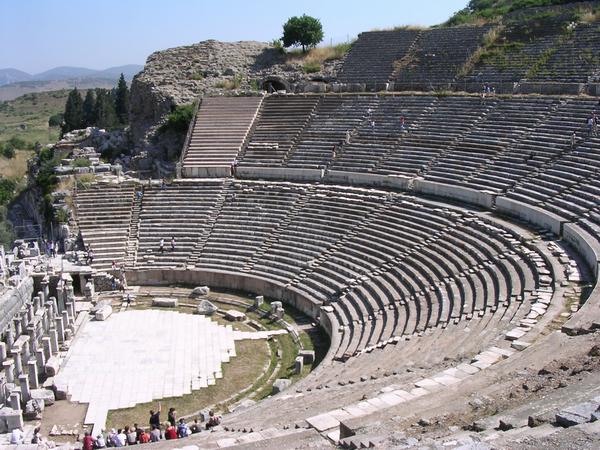
Oh my. Now, let me interject… I’ve been to Ephesus. I’ve sat in this amphitheater and let me tell you…this isn’t some quaint outdoor theater! This place is HUGE. As I sat in this theater, I imagined the mob – screaming for two hours. It’s hard to imagine how loud it must have been. The whole city would have heard, for the amphitheater was close to the main thoroughfare of the city.

ephesus

Paul wanted to go to the theater. Who knows why! But, thankfully, the disciples prevented Paul from going. We learn something about Paul’s character. He was not a coward!

Here’s what’s cool…. Do you remember what the mob was screaming about? Artemis, the goddess. Have you ever heard of this goddess? Does she have any influence over your life? Did she change the course of history?? I didn’t think so.

The mob can scream all they want to – the fact is… the city of Ephesus and their precious goddess, Artemis, are in ruins. But Jesus, the God of creation and of all of history – stands forever.

Day 202: Genealogy and Exorcisms (seriously)

1 Chronicles 1-3; Acts 19:1-20

Key Verses

Acts 19:8-10
And he entered the synagogue and for three months spoke boldly, reasoning and persuading them about the kingdom of God. But when some became stubborn and continued in unbelief, speaking evil of the Way before the congregation, he withdrew from them and took the disciples with him, reasoning daily in the hall of Tyrannus. This continued for two years, so that all the residents of Asia heard the word of the Lord, both Jews and Greeks.

We are going back to the historical books! 1 Chronicles was written after the exiles returned to Jerusalem to rebuild the temple, the city, and their lives. The writer of 1 Chronicles wanted to remind the Jewish remnant (who had returned from exile) of their history and renew hope in the covenant promises of God.

The writer was a priest and placed considerable value on the building of Solomon’s temple and practices of the priests. He also idealized the reigns of David and Solomon – maybe to renew the hope of a Messianic ruler that would come from the line of David.

He begins his writings with a long genealogy – beginning with Adam and continuing all the way to the post-exilic period. His purpose was to rebuild the people’s identity – to give them context and purpose in their rebuilt Jerusalem.

Transitioning to Acts 19, we read of Paul’s extended ministry in Ephesus. When reading, we must remember the heavy pagan influence on the culture. In this culture, healings and authority over evil spirits gave credibility to the gospel. In our culture, the gospel gains credibility differently (probably more through kindness and great personal sacrifice rather than exorcizing evil spirits ;) But it’s the same gospel and the same Spirit at work!

Luke makes this point at the end of our reading…

So the word of the Lord continued to increase and prevail mightily (Acts 19:20).

Was it Paul that prevailed mightily? Did the gospel go forth because Paul had a special skill or knowledge? No, it was the word of the Lord that increased and prevailed! Paul was a willing and obedient servant, so God used him mightily as a vehicle for His Word to prevail. So it is with us. We do not prevail because of all our special programs and ministries. It is the word of the Lord at work in us that prevails in our culture and in our world. We must be willing, but God does the work!

Day 200: The Prince

Ezekiel 45-46; Acts 17:16-34

Key Verses

Ezekiel 46:9-10
“When the people of the land come before the Lord at the appointed feasts, he who enters by the north gate to worship shall go out by the south gate. […] When they enter, the prince shall enter with them, and when they go out, he shall go out.”

Acts 17:30-31
The times of ignorance God overlooked, but now he commands all people everywhere to repent, because he has fixed a day on which he will judge the world in righteousness by a man whom he has appointed; and of this he has given assurance to all by raising him from the dead.”

Today’s reading from Ezekiel continues his final vision of a restored and rebuilt temple. Yesterday, we read how God’s glory returned to his temple. God entered the temple through the outermost East Gate. Ezekiel 45 opens with the declaration that this gate should remain shut – no one shall ever enter or exit through this gate again. This implies that God will not be leaving. His presence with His people is permanent. It is eternal.

But one allowance is made…

Only the prince may sit in [the East gate] to eat bread before the Lord. He shall enter by way of the vestibule of the gate, and shall go out by the same way (Ezekiel 45:3).

The prince. He is an interesting character. This is the first mention of him in this vision, but Ezekiel has made mention of a prince before in 34:23-24 and 37:24-25. These passages refer to the prince as “my servant David” and having “forever” rule.

Ezekiel’s language echoes Jeremiah’s prophecies concerning this future leader…

Behold, the days are coming, declares the Lord, when I will raise up for David a righteous Branch, and he shall reign as king and deal wisely, and shall execute justice and righteousness in the land (Jeremiah 23:5).

These words from Jeremiah match perfectly the descriptions of the prince in Ezekiel’s vision. The prince is to ensure justice (45:7-12) and be a leader in worship (45:17; 22). Even though he is set apart to share fellowship with God in the holy East gate, he is still considered to be one of the people. He is instructed to enter the temple when the people go in, and exit the temple when the people go out (46:10). He is one of them. He identifies with them.

Does this sound like someone you know??

Paul spoke of Him to the philosophers of Athens. He said that God had appointed a man who will “judge the world in righteousness” (Acts 17:31). Isn’t that what Jeremiah said? And isn’t that what Ezekiel described?

Friends, our prince is Jesus. He is just. He sits at God’s right hand and intercedes for us because he identifies with us. He rules with righteousness. And his love for us compelled him to die in our place. What else could we ask for? What else could we need?

Day 199: God’s Glory Descends

Ezekiel 43-44; Acts 17:1-15

Key Verses

Ezekiel 43:1-5
Then he led me to the gate, the gate facing east. And behold, the glory of the God of Israel was coming from the east. And the sound of his coming was like the sound of many waters, and the earth shone with his glory. And the vision I saw was just like the vision that I had seen when he came to destroy the city, and just like the vision that I had seen by the Chebar canal. And I fell on my face. As the glory of the Lord entered the temple by the gate facing east, the Spirit lifted me up and brought me into the inner court; and behold, the glory of the Lord filled the temple.

Ezekiel’s first temple vision – before Solomon’s temple was destroyed – ended with God’s glory leaving the temple through the East gate (Ezekiel 11:22-23). In Ezekiel’s second temple vision, we read of God’s glory returning to a rebuilt temple through the East gate (Ezekiel 43:1-5).

No matter to what interpretation you ascribe, whether you believe this future temple will be rebuilt physically or whether this temple is symbolic of God’s relationship with His people in some future age… The return of God’s glory to dwell among His people is the most important aspect of Ezekiel’s vision!!

Yes, Ezekiel goes into great detail to describe the sacrifices and duties of the priests. It all harkens back to the giving of the Mosaic law in Exodus and Leviticus. These are all important reminders of God’s holiness and our need for a sacrificial Savior… But the returning of the Glory of God is the climax!

In the Old Testament, the temple was the dwelling place of God’s glory. We see this in Exodus as God’s glory descended upon the tabernacle (Ex 40:34-35) – and in 1 Kings as God’s glory descended upon Solomon’s temple (1 Kings 8:10-11). But in the New Testament, God’s presence dwells among his people in the context of the church.

As Paul and his companions were traveling through Macedonia, they weren’t just creating individuals who believed in Jesus… No, they were creating communities, congregations… they were planting churches. In Acts 17, Paul visited Thessalonica and Berea, but when he left those places, he left behind groups of people who would meet together to worship Jesus as God. He left behind churches.

Paul makes it clear that because of Jesus’s final sacrifice, the temple has been replaced by the church as the worship center for the believer.

Do you not know that you are God’s temple and that God’s Spirit dwells in you? If anyone destroys God’s temple, God will destroy him. For God’s temple is holy, and you are that temple (1 Corinthians 3:16-17).

The “you” in these verses is plural. Paul is talking to a collective “you.” He is talking to the church. 

In the past, God’s glory descended upon the Holy of Holies in the innermost chamber of his temple. In the future new Jerusalem, there will be no need for a temple, “for its temple is the Lord God the Almighty and the Lamb” (Revelation 21:22). But right now, in this present age… the temple is us, the church. And God’s glory has descended, and God’s glory dwells among us! That, friends, is something to celebrate!