
Day 211: Israel’s political disparity

1 Chronicles 25-27; Acts 24

The political contrast between Israel in the Old and New Testaments is wide.

David would always be the “standard” for Israelite kings. Today we read of all the people he organized for temple service, as well as the thousands he commanded who served in the nation’s military. Israel was a major world power. David extended Israel’s borders and had significant political weight in the world.

Jesus was born into a very different Israel. It was no longer a sovereign nation, but was ruled by Rome. Rome instituted its own governors and officials throughout all of Israel. Even though the Jews maintained the Sanhedrin, their own religious ruling council, they had no true governmental control.

The Jews had been waiting for a “Messiah” to come and re-establish Israel as a major world power. One of the reasons Jesus was rejected as Messiah by most of the Jewish council was that he wasn’t a political figure. They couldn’t accept the radically different notion that Jesus came to establish a heavenly or spiritual Kingdom on earth.

Consequently, the Jewish Sanhedrin was very much against the new sect of Jews who believed Jesus to be their Messiah. First, they didn’t want this new sect stealing even an ounce of their limited power and influence. And secondly, I imagine the thought of a Messiah having come and not returning sovereign rule to Israel – was… well – a very bitter pill to swallow.

So, in today’s reading – we see Paul, standing before Felix, the Roman governor of Judea. Felix organized a trial, and the Jewish council sent a delegation from Jerusalem to testify against Paul.

The entire conflict between the Jews and Paul could be summarized in one word: Resurrection. Paul, himself, admitted this to Felix when he said…

It is with respect to the resurrection of the dead that I am on trial before you this day (Acts 23:21).

The resurrection of Jesus was just as world-changing – just as life-altering back then as it is today. If Jesus’ resurrection was FACT, then his claims to deity were true, and the Jewish Sanhedrin would be forced to accept that they killed the Messiah. And if Jesus was really the Messiah, all of their hopes and aspirations for a Sovereign Israel would be lost. There was just too much to lose. It was much easier for the Sanhedrin to turn a blind eye to the facts, than to admit the truth of Jesus’ resurrection.

Their lust for power was so strong that they were willing to do anything to silence Paul. Even break their own law (and Roman law) to conspire to kill him.

But God used Felix, the corrupt Roman governor, to protect Paul from ambush and death. Indifferent to Paul’s innocence, Felix kept Paul imprisoned, albeit comfortably, for two years. What better way to protect Paul from the rage of the Jewish Sanhedrin than to keep him locked up in a Roman prison!!! What men intended for evil, God worked out for good!
Day 203: Genealogy and Riots

1 Chronicles 4-6; Acts 19:21-41

In 1 Chronicles, the genealogy continues… But in Acts, there is quite the uproar :)

But let’s not get ahead of ourselves…

This passage begins by outlining Paul’s travel itinerary that will comprise the rest of the book of Acts. He “resolved in his spirit” to visit the churches in Macedonia (Philippi, Thessalonica & Berea), then of Achaia or Greece (Corinth). He then planned to return to Jerusalem and ultimately, Rome (Acts 19:21).

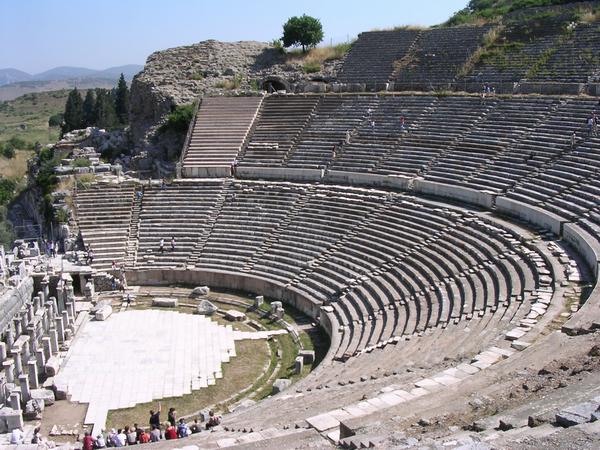
Then the passage returns to events occurring in Ephesus. It would seem that Paul’s ministry was hurting the business of the idol-makers. One specific silver-smith, Demetrius, was especially perturbed, so he decided to assemble his cohorts and accused the disciples of slandering the “great goddess Artemis.” This small assembly multiplied into a riot – with all the crowds piling into the great amphitheatre and shouting for TWO HOURS, “Great is Artemis of the Ephesians!”

Oh my. Now, let me interject… I’ve been to Ephesus. I’ve sat in this amphitheatre and let me tell you…this isn’t some quaint outdoor theater! This place is HUGE. As I sat in this theatre, I imagined the mob – screaming for two hours. It’s hard to imagine how loud it must have been. The whole city would have heard, for the amphitheatre was close to the main thoroughfare of the city.

ephesus

Paul wanted to go to the theater. Who knows why! But, thankfully, the disciples prevented Paul from going. We learn something about Paul’s character. He was no coward, that’s for sure!

Here’s what’s cool…. Do you remember what the mob was screaming about? That’s right…Artemis, the goddess. Have you ever heard of this goddess? Does she have any influence over your life? Did she change the course of history?? I didn’t think so.

The mob can scream all they want to – the fact is… the city of Ephesus and their precious goddess, Artemis, are in ruins. But Jesus, the God of creation and of all of history – stands forever.

Day 200: The Prince

Ezekiel 45-46; Acts 17:16-34

Today’s reading from Ezekiel continues his final vision of a restored and rebuilt temple. Yesterday, we read how God’s glory returned to his temple. God entered the temple through the outermost East Gate. Ezekiel 45 opens with the declaration that this gate should remain shut – no one shall ever enter or exit through this gate again. This implies that God will not be leaving. His presence with His people is permanent. It is eternal.

But one allowance is made…

Only the prince may sit in [the East gate] to eat bread before the Lord. He shall enter by way of the vestibule of the gate, and shall go out by the same way (Ezekiel 45:3).

The prince. He is an interesting character. This is the first mention of him in this vision, but Ezekiel has made mention of a prince before in 34:23-24 and 37:24-25. These passages refer to the prince as “my servant David” and having “forever” rule.

Ezekiel’s language echoes Jeremiah’s prophecies concerning this future leader…

Behold, the days are coming, declares the Lord, when I will raise up for David a righteous Branch, and he shall reign as king and deal wisely, and shall execute justice and righteousness in the land (Jeremiah 23:5).

These words from Jeremiah match perfectly the descriptions of the prince in Ezekiel’s vision. The prince is to ensure justice (45:7-12) and be a leader in worship (45:17; 22). Even though he is set apart to share fellowship with God in the holy East gate, he is still considered to be one of the people. He is instructed to enter the temple when the people go in, and exit the temple when the people go out (46:10). He is one of them. He identifies with them.

Does this sound like someone you know??

Paul spoke of Him to the philosophers of Athens. He said that God had appointed a man who will “judge the world in righteousness” (Acts 17:31). Isn’t that what Jeremiah said? And isn’t that what Ezekiel described?

Friends, our prince is Jesus. He is just. He sits at God’s right hand and intercedes for us because he identifies with us. He rules with righteousness. And his love for us compelled him to die in our place. What else could we ask for? What else could we need?

Day 197: Two visions

Ezekiel 40; Acts 16:1-15

I just read in one of my commentaries… “Interpreters do agree on one point… Ezekiel 40-48 is one of the most difficult passages in the entire Bible.” Great.

I know why it is difficult. These prophecies have not been fulfilled, and therefore, theologians have different interpretations of its meaning.

Ezekiel 40-48 is the 2nd “temple vision” in Ezekiel. The first vision in chapters 8-11 showed the abominations of idolatrous people before the destruction of the temple. This second vision occurs 14 years (to the day) after the fall of the city and the destruction of the temple. Through visions, God shows Ezekiel a vision of a future, rebuilt and restored temple.

Here’s the controversy… Some scholars believe this vision is a literal temple that will be built one day in the future. Others believe this rebuilt temple is symbolic of God’s presence with his people during our current church age – and still others believe this vision is symbolic of perfect worship in the New Earth.

Not that it matters much… but I lean toward a symbolic interpretation of this vision – especially since Ezekiel was a priest (in his life in Judea) and would have been extremely familiar with the old temple. Temple life would have been deeply valuable to Ezekiel, so it makes sense that God would wrap the restoration of Israel in the context of a symbolically “perfect” temple.

But let’s look at the text… This video is especially helpful in picturing the temple as Ezekiel describes it in Chapter 40. Just a word of caution… this is one person’s visual interpretation. It is helpful, but not authoritative :)

Moving on to Acts 16, we read of the beginning of Paul’s 2nd missionary journey where the text describes another vision! In this case, God used the vision to direct Paul to preach the gospel in far-away Europe. So Paul obeyed, traveling north into the Roman colony of Philippi. Philippi was so far removed from Jewish culture that there wasn’t even a Jewish temple! Undeterred, Paul and his companions approached a group of women who were praying by a riverside.

From a human perspective, this makes no sense. Why go north to Philippi instead of south to more familiar territory? Why approach women instead of the influential men of the city? But God’s ways are not our ways.

God planned for the first convert in Europe to be an ordinary woman named Lydia. The church in Philippi started in her house and grew to be a major influence in the region. The influence of the church in Philippi ripples to this day as we are instructed by the letter that Paul wrote to the Philippian church.

God used Paul’s obedience in the face of ambiguity to bring the gospel to the ends of the earth! Has God ever asked something of you that didn’t make earthly sense?? I have found that obedience in the face of ambiguity brings about the richest blessings. May we have the faith to follow Jesus… wherever He may lead!

Day 193: The Good Shepherd

Ezekiel 33-34; Acts 13

Let it be known to you therefore, brothers, that through [Jesus] forgiveness of sins is proclaimed to you, and by him everyone who believes is freed from everything from which you could not be freed by the law of Moses (Acts 13:38-39).

We know the end for those who are under the law of Moses… death by sword, famine, pestilence and disease. In Ezekiel 33, Ezekiel receives word that the city of Jerusalem has fallen. All of his warnings have come to pass. What Jeremiah witnessed firsthand, Ezekiel must hear from a fugitive (Ezekiel 33:21).

The way of the law is destruction – not because the law is corrupt.. No! Rather, because we are corrupt!! We need a Savior. We desperately need a Savior!

And in Ezekiel 34, we read of our Savior. He is our Shepherd. We are his sheep. He gathers us and protects us. Jesus harkens back to this passage when He proclaims In John 10, “I am the Good Shepherd.” In this same chapter, Jesus expands the “sheep” to include Gentiles…

And I have other sheep that are not of this fold. I must bring them also, and they will listen to my voice. So there will be one flock, one shepherd (John 10:16).

Which leads us to Paul in Acts 13. Paul has embarked on his first missionary journey and here we read Paul’s beautiful presentation of the gospel.

His message created quite a stir in Antioch – so much so that “almost the whole city gathered to hear the word of the Lord.” And since Antioch was primarily Gentile, that meant that Gentiles crowded the Jewish synagogue to hear Paul’s message.

Paul always went to the synagogues first to proclaim the good news of the fulfillment of the Law and the Prophets, but it was the Gentiles that responded with joy and faith (Acts 13:48).

This is the Good Shepherd bringing in the other sheep. This is the Good Shepherd opening the door to us! We are now members of his flock. He is our Good Shepherd, and we are to follow Him. How could we not?? Sheep are helpless without the Shepherd.

Day 192: Sovereignty and Power

Ezekiel 29-32

Consider God’s sovereignty as he used the king of Babylon as an instrument of His wrath against the nations, and specifically, against Egypt, as described in these chapters.

Our God controls the will of kings. He causes them to rise and fall. He uses them for his purposes. The ramifications of this kind of Sovereignty are both awe-inspiring and terrifying…

And even more amazing to me is that Ezekiel’s prophecies against Egypt actually came true! Consider this prophecy: “Behold, I will give the land of Egypt to Nebuchadnezzar king of Babylon; and he shall carry off its wealth and despoil it and plunder it; and it shall be the wages for his army” (Ezekiel 29:19). Check out what the ESV Study Bible says about this verse…

This prophecy was given in 571 b.c. and Nebuchadnezzar conquered Egypt in 568 (this is described in detail in Jeremiah 43–44 and also recorded in Josephus, Jewish Antiquities 10.180–182). Egypt was subsequently subject to Persian rule (beginning in 525 b.c.), was conquered by Alexander the Great and made part of his empire in 332, and was conquered by the Romans and became part of the Roman Empire in 31. (Crossway)

Egypt never regained its power in the world. Never. Ezekiel’s prophecy was fulfilled just a few years after it was made! The most powerful rulers on this earth are mites compared to God and his sovereignty.

Who is this God we serve? Who is He who builds and destroys, blesses and curses? Are we subservient to a harsh, selfish Ruler who destroys on a whim? Or do we serve a God who has created us in His image, who molds us with the tender care of a Father, who is preparing us for an eternity shared with Himself?

We must keep the person of Jesus in our minds as we consider God’s sovereignty and power. Jesus came to save, not to destroy. Jesus was the manifestation of God’s glory on earth – and because of Jesus, we do not have to face the wrath of God. He faced it for us. And considering the suffering that Judah endured… I am extremely grateful to be spared from the wrath of God!

Day 190: Inside the mind of an exile

Ezekiel 24-25; Acts 11

Imagine being captured and sent to a foreign land. You would be separated from your family – your sons, your daughters, your friends. And if you were one of the first exiles to leave Jerusalem, the only news of your homeland would come from a man named, Ezekiel.

You knew He was one of the Lord’s true prophets because he only spoke when God opened his mouth to speak. Otherwise… he was mute (Ezekiel 3:26-27). So each time he spoke, you listened, and hoped for good news – but he only had messages of judgment.

So you ignored him, and went about your relatively free existence in a foreign land. You settled down in your own house and built a new family. But one day, in the 9th year, in the tenth month, on the tenth day of the month of king Zedekiah’s reign, God opened Ezekiel’s mouth and he spoke a parable that was so terrifying, so horrible that you couldn’t ignore it. God’s last words would stay with you. And shake you…

I am the Lord. I have spoken; it shall come to pass; I will do it. I will not go back; I will not spare; I will not relent; according to your ways and your deeds you will be judged, declares the Lord God (Ezekiel 24:14).

And you knew, your beloved nation and city and people would be destroyed. And then, something unexpected and strange happened…

Ezekiel’s beloved wife died, the delight of his eyes, and he refused to mourn for her. So you wondered and you asked, “Why are you acting so strangely Ezekiel? Does this have meaning for us exiles?”

And Ezekiel confirmed your worst fears – that Jerusalem and the temple and the people would fall by the sword. And that God commanded that you, too, would not mourn – that you were to not show any outward signs of grief.

And you might wonder your whole life why… Why so much suffering, Lord? Why were we not allowed to grieve? 

Now imagine that after you died, and hundreds of years passed by, you were able to see the Son of God squeeze into human form and show God’s glory to your people. But in a horrible twist, He received an even more severe judgment than that of Jerusalem. Then you would know… that you shared in the sufferings of God.

God suffered as he watched his beloved Jerusalem burn to ashes – and he suffered as he watched his Son endure the shame and agony of a criminal’s cross. And Ezekiel suffered as his wife died and the exiles suffered in a foreign land knowing that their home was lost.

Have you ever wondered… “Why? Why so much suffering Lord?” In many ways, knowing that you share in the sufferings of God – answers the question “Why?” There is purpose for the pain. There always is.

Day 189: Building the church

Ezekiel 22-23; Acts 10:24-48

And the believers from among the circumcised who had come with Peter were amazed, because the gift of the Holy Spirit was poured out even on the Gentiles (Acts 10:45).

From the days of Abraham, God had promised to create a people for himself, a nation, to call His own. And he did. He called them. He freed them. And he established them. But they chased after other gods. They played the whore…

Therefore thus says the Lord God: Because you have forgotten me and cast me behind your back, you yourself must bear the consequences of your lewdness and whoring (Ezekiel 23:35).

So God judged His people, but promised to restore them. And He did. Then the people rebelled again, not by whoring after the gods of other nations, but by worshipping the god of self-righteousness.

So instead of judging his people, God sent His son, to take the Judgment His people deserved. And through His son, all the people of the world were blessed.

God threw open the doors to His Kingdom and invited all of His nation in, but very few responded. So… God invited others – the uncircumcised sort – the unclean Gentile. He invited them all into His Kingdom. And they came, and are still coming, along with their Jewish brothers, to this day.

God is bigger than the idolatry of a chosen nation. He can use it to bless all the nations, and is working to build His church, to this day!

Day 188: Longing for the good…

Ezekiel 20-21; Acts 10:1-23

I was just talking with my 10-year-old son about Ezekiel…

Me: I’m so tired of the heavy judgment oracles. They just seem especially… harsh.
Him: Is the whole book that way?
Me: No, only half. The last half contains visions of hope and restoration.
Him: Well there’s your explanation, Mom. The contrast is the point. If the judgment weren’t so dark, then the restoration wouldn’t seem as sweet.

I think he has a point. But it doesn’t make the first half of the book any easier to bear… at least for me.

In Acts, we begin the long narrative of Peter and Cornelius, the Gentile Centurion. This account lays the foundation for the inclusion of Gentiles in the church and the cessation of clean/unclean guidelines and other ceremonial laws – including festivals and circumcision.

All of these laws were established to make Israel unique among the nations and point to Christ as the ultimate sacrifice for sin. After Christ came and opened the Kingdom to people from all tribes and nations, the need to distinguish a nation through ceremonial laws was made obsolete. Christians are to be characterized by love for their neighbor that comes through a circumcised heart – not the external sign of circumcision.

The promise of Ezekiel looks forward to this Church age…

And I will give you a new heart, and a new spirit I will put within you. And I will remove the heart of stone from your flesh and give you a heart of flesh (Ezekiel 36:26).

See… there is good news in Ezekiel ;)

Day 186: Incomprehensible Grace

Ezekiel 15-16; Acts 9:1-22

Both of today’s passages are some of the most well-known of the Bible.

Ezekiel 16 is the graphic metaphor of Israel playing the whore. The descriptions of Israel’s harlotry border on grotesque – reflecting the seriousness of Israel’s sin.

In Acts, we read of Saul’s conversion on the road to Damascus. This amazing story introduces Saul as a zealous persecutor of the church, and for some divine reason, Jesus chooses this arrogant “Jew among Jews” to take the gospel to the ends of the earth!

These passages have one thread – one aspect of God’s character in common… his incomprehensible Grace.

After sixty-one verses of Ezekiel’s graphic descriptions of Israel’s sin, you might think that Israel is beyond hope – that they’ve gone too far, that there is nothing to be redeemed, nothing left to be restored… UNTIL, the very end of the chapter…

I will establish my covenant with you, and you shall know that I am the Lord, that you may remember and be confounded, and never open your mouth again because of your shame, when I atone for you for all that you have done, declares the Lord God (Ezekiel 16:62-63).

He promises to atone for the sins of his people. We know the price of the atonement. We know the depth of the sacrifice that was made for this sinful people, for Israel, for the remnant, for us.

And then think about Saul… There is no better example of the power of God’s grace than in the transformation of Saul’s life. Jesus, the one who gave his life for our sins, appeared to Saul and asked Saul why he was persecuting Him, the risen Lamb of God.

If God’s grace can transform Saul, God’s grace can transform anybody… even me!