
Day 204: Genealogy and Deathly long sermons

1 Chronicles 7-9; Acts 20:1-16

The long genealogy of Israel ends in today’s reading from 1 Chronicles. The “Chronicler” has framed Israel’s entire history in the context of genealogical lists!

Remember, the Chronicler lived in post-exile Jerusalem and wanted to remind the people of their history and heritage. The structure* of these nine chapters reveals his purposes…

  • He covers Judah first… the royal tribe, the lineage of King David, and the main tribe of the southern kingdom.
  • He ends with Benjamin, using the tribes of the southern kingdom to bracket* the other tribes.
  • In the very center, or heart* of the genealogies, is the Levite tribe – representing the spiritual heart of the nation.
  • The inclusion of the northern tribes affirms that God considered all of Israel his chosen people – and there were some from the northern tribes living in the post-exile Jerusalem.

If you drill down into each tribe’s genealogies, they were strategically structured to remind the people of their heritage. He recounted how both the northern and southern tribes “broke faith” with God (1 Chronicles 5:25-26, 1 Chronicles 9:1, respectively). Since they were on the other side of judgment, he was trying to point to God’s grace of restoration – so that they might order their lives around the law of God and experience a more full restoration.*

If the detailed genealogies in 1 Chronicles aren’t enough, we are inundated with even more details, as we read about Paul’s travels in Acts. Sandwiched between these details, however, is a humorous story of Paul boring a young man to sleep with his “prolonged speech.” And then, as Paul “talked still longer,” the man was sleeping so soundly that he fell from the third story window and died! Thankfully, Paul was given the power to revive him. This “interruption” was no deterrent to Paul who kept right on talking until daybreak.

Hidden in the humor of this story is a glimpse of Paul’s character… He was wholly devoted to his mission to teach the gospel. Nothing would distract him – not even the death of a bored seeker!

Think of how easily we are distracted by both the pleasures and plights of this world. We must not be distracted! We must keep our eyes fully focused on His word and work in this world!!

*ideas or words with an asterisk (*) came from the study notes of the ESV Study Bible (Crossway).
Day 203: Genealogy and Riots

1 Chronicles 4-6; Acts 19:21-41

In 1 Chronicles, the genealogy continues… But in Acts, there is quite the uproar :)

But let’s not get ahead of ourselves…

This passage begins by outlining Paul’s travel itinerary that will comprise the rest of the book of Acts. He “resolved in his spirit” to visit the churches in Macedonia (Philippi, Thessalonica & Berea), then of Achaia or Greece (Corinth). He then planned to return to Jerusalem and ultimately, Rome (Acts 19:21).

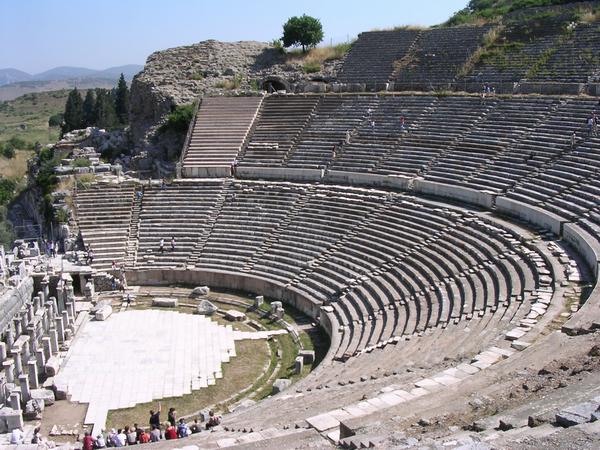
Then the passage returns to events occurring in Ephesus. It would seem that Paul’s ministry was hurting the business of the idol-makers. One specific silver-smith, Demetrius, was especially perturbed, so he decided to assemble his cohorts and accused the disciples of slandering the “great goddess Artemis.” This small assembly multiplied into a riot – with all the crowds piling into the great amphitheatre and shouting for TWO HOURS, “Great is Artemis of the Ephesians!”

Oh my. Now, let me interject… I’ve been to Ephesus. I’ve sat in this amphitheatre and let me tell you…this isn’t some quaint outdoor theater! This place is HUGE. As I sat in this theatre, I imagined the mob – screaming for two hours. It’s hard to imagine how loud it must have been. The whole city would have heard, for the amphitheatre was close to the main thoroughfare of the city.

ephesus

Paul wanted to go to the theater. Who knows why! But, thankfully, the disciples prevented Paul from going. We learn something about Paul’s character. He was no coward, that’s for sure!

Here’s what’s cool…. Do you remember what the mob was screaming about? That’s right…Artemis, the goddess. Have you ever heard of this goddess? Does she have any influence over your life? Did she change the course of history?? I didn’t think so.

The mob can scream all they want to – the fact is… the city of Ephesus and their precious goddess, Artemis, are in ruins. But Jesus, the God of creation and of all of history – stands forever.

Day 202: Genealogy and Exorcisms (seriously)

1 Chronicles 1-3; Acts 19:1-20

We are going back to the historical books! 1 Chronicles was written after the exiles returned to Jerusalem to rebuild the temple, the city and their lives. The writer of 1 Chronicles wanted to remind the Jewish remnant (who had returned from exile) of their history and renew hope in the covenant promises of God.

The writer was a priest and placed considerable value on the building of Solomon’s temple and practices of the priests. He also idealized the reigns of David and Solomon – maybe to renew the hope of a Messianic ruler that would come from the line of David.

He begins his writings with a long genealogy – beginning with Adam and continuing all the way to the post-exilic period. His purpose was to rebuild the people’s identity – to give them context and purpose in their rebuilt Jerusalem.

Transitioning to Acts 19, we read of Paul’s extended ministry in Ephesus. When reading, we must remember the heavy pagan influence on the culture. In this culture, healings and authority over evil spirits gave credibility to the gospel. In our culture, the gospel gains credibility differently (probably more through kindness and great personal sacrifice rather than exorcising evil spirits ;) But it’s the same gospel and the same Spirit at work!

Luke makes this point at the end of our reading…

So the word of the Lord continued to increase and prevail mightily (Acts 19:20).

Was it Paul that prevailed mightily? Did the gospel go forth because Paul had a special skill or knowledge? No, it was the word of the Lord that increased and prevailed! Paul was a willing and obedient servant, so God used him mightily as a vehicle for His Word to prevail. So it is with us. We do not prevail because of all our special programs and ministries. It is the word of the Lord at work in us that prevails in our culture and in our world. We must be willing, but God does the work!

Day 201: The Lord is Here

Ezekiel 47-48; Acts 18

Today, we come to the end of Ezekiel’s vision of a rebuilt and restored temple – and also to the end of the book!

We read of waters that trickle from the inner sanctuary and flow out of the temple forming a river with extraordinary life-giving properties. The vision continues with an idealized allotting of land to the 12 tribes – including land for the Prince, Levites and common ground for food to be harvested for the workers of the city.

The vision ends with the gates of the city described… One gate for each son of Jacob. It points forward to the imagery used to describe the new Jerusalem in Revelation 21:12-14.

In a most striking ending, Ezekiel reveals the name of this city – located just south of the rebuilt temple… Its name is “The Lord is There.” This name summarizes the entire emphasis of Ezekiel… The first half of the book described Judah’s gross sin which led to God leaving the temple and his people. The second half is filled with promises of restoration culminating in this final temple vision describing how God’s glory will return to the rebuilt temple.

This is all wonderful, but it hasn’t happened yet! We know and trust that God will dwell with His people forever in the new Jerusalem. But what about now? Where is God now?

Well… we see evidence of His sovereignty and Presence in today’s reading from Acts…

From leading Paul to stay in Corinth – to multiplying Paul’s ministry into Priscilla and Aquila – who then teach and train the effective minister, Apollos… God’s Spirit is at work. God is at work leading and building, equipping and empowering. The Corinthian and Ephesian churches experienced the power of His presence. His Spirit lived in them, and His Spirit lives in us.

Where is He now? The Lord is here!

Day 200: The Prince

Ezekiel 45-46; Acts 17:16-34

Today’s reading from Ezekiel continues his final vision of a restored and rebuilt temple. Yesterday, we read how God’s glory returned to his temple. God entered the temple through the outermost East Gate. Ezekiel 45 opens with the declaration that this gate should remain shut – no one shall ever enter or exit through this gate again. This implies that God will not be leaving. His presence with His people is permanent. It is eternal.

But one allowance is made…

Only the prince may sit in [the East gate] to eat bread before the Lord. He shall enter by way of the vestibule of the gate, and shall go out by the same way (Ezekiel 45:3).

The prince. He is an interesting character. This is the first mention of him in this vision, but Ezekiel has made mention of a prince before in 34:23-24 and 37:24-25. These passages refer to the prince as “my servant David” and having “forever” rule.

Ezekiel’s language echoes Jeremiah’s prophecies concerning this future leader…

Behold, the days are coming, declares the Lord, when I will raise up for David a righteous Branch, and he shall reign as king and deal wisely, and shall execute justice and righteousness in the land (Jeremiah 23:5).

These words from Jeremiah match perfectly the descriptions of the prince in Ezekiel’s vision. The prince is to ensure justice (45:7-12) and be a leader in worship (45:17; 22). Even though he is set apart to share fellowship with God in the holy East gate, he is still considered to be one of the people. He is instructed to enter the temple when the people go in, and exit the temple when the people go out (46:10). He is one of them. He identifies with them.

Does this sound like someone you know??

Paul spoke of Him to the philosophers of Athens. He said that God had appointed a man who will “judge the world in righteousness” (Acts 17:31). Isn’t that what Jeremiah said? And isn’t that what Ezekiel described?

Friends, our prince is Jesus. He is just. He sits at God’s right hand and intercedes for us because he identifies with us. He rules with righteousness. And his love for us compelled him to die in our place. What else could we ask for? What else could we need?

Day 199: God’s glory descends

Ezekiel 43-44; Acts 17:1-15

Ezekiel’s first temple vision – before Solomon’s temple was destroyed – ended with God’s glory leaving the temple through the East gate (Ezekiel 11:22-23). In Ezekiel’s second temple vision, we read of God’s glory returning to a rebuilt temple through the East gate (Ezekiel 43:1-5).

No matter to what interpretation you ascribe, whether you believe this future temple will be re-built physically or whether this temple is symbolic of God’s relationship with His people in some future age… The return of God’s glory to dwell among His people is the most important aspect of Ezekiel’s vision!!

Yes, Ezekiel goes into great detail to describe the sacrifices and duties of the priests. It all harkens back to the giving of the Mosaic law in Exodus and Leviticus. These are all important reminders of God’s holiness and our need for a sacrificial Savior… But the returning of the Glory of God is the climax!

In the Old Testament, the temple was the dwelling place of God’s glory. We see this in Exodus as God’s glory descended upon the tabernacle (Ex 40:34-35) – and in 1 Kings as God’s glory descended upon Solomon’s temple (1 Kings 8:10-11). But in the New Testament, God’s presence dwells among his people in the context of the church.

As Paul and his companions were traveling through Macedonia, they weren’t just creating individuals who believed in Jesus… No, they were creating communities, congregations… they were planting churches. In Acts 17, Paul visited Thessalonica and Berea, but when he left those places, he left behind groups of people who would meet together to worship Jesus as God. He left behind churches.

Paul makes it clear that because of Jesus’s final sacrifice, the temple has been replaced by the church as the worship center for the believer.

Do you not know that you are God’s temple and that God’s Spirit dwells in you? If anyone destroys God’s temple, God will destroy him. For God’s temple is holy, and you are that temple (1 Corinthians 3:16-17).

The “you” in these verses is plural. Paul is talking to a collective “you.” He is talking to the church. 

In the past, God’s glory descended upon the Holy of Holies in the innermost chamber of his temple. In the future new Jerusalem, there will be no need for a temple, “for its temple is the Lord God the Almighty and the Lamb” (Revelation 21:22). But right now, in this present age… the temple is us, the church. And God’s glory has descended, and God’s glory dwells among us! That, friends, is something to celebrate!

Day 198: A little goes a long way

Ezekiel 41-42; Acts 16:16-40

Ezekiel 41-42 continues the detailed description of the rebuilt, restored temple of Ezekiel’s vision. (For interpretations of these chapters, see yesterday’s post).

If you watched the 3D visualization of Ezekiel 40, the makers of that video have two additional videos that depict Ezekiel 41-43. Again, they are very helpful, but not authoritative in their interpretation.

For Ezekiel 41, click here.
For Ezekiel 42-43, click here.

Yesterday in Acts, we read of Lydia, the first convert of the Philippian church. Today, we read of another convert… the jailer. He and his entire household were saved.

What is so fascinating about this entire chapter – is how obvious it is that God is the one at work. Paul, Silas and Luke are faithful to preach the gospel, but they cannot open hearts to understand the truth or replace a heart of stone with a heart of flesh. God is the one who does that… in both Lydia and the jailer.

This little Philippian church is a miraculous work of the Spirit. And don’t think that because they were small in number, that they had little impact on the world. On the contrary, Paul later testifies to the generosity of this church to the Corinthians…

We want you to know, brothers, about the grace of God that has been given among the churches of Macedonia, for in a severe test of affliction, their abundance of joy and their extreme poverty have overflowed in a wealth of generosity on their part. For they gave according to their means, as I can testify, and beyond their means, of their own accord, begging us earnestly for the favor of taking part in the relief of the saints (2 Corinthians 8:1-4).

We can infer from this passage that after Paul left Philippi, the church suffered through affliction and poverty. Yet, they had “abundance of joy” and it “overflowed in a wealth of generosity.”

They stand as an example to us today. Whatever our circumstances, we are called to care for the poor and needy around us. As a Christian, we are to pattern our lives after Christ – which means we are to live life sacrificially. This is impossible apart from the work of the Spirit in our lives!

God, help me take my eyes off of my own suffering and open my eyes to see how I might enter into someone else’s world. Help me life a life of sacrifice… wholly devoted to you. Amen.

Day 197: Two visions

Ezekiel 40; Acts 16:1-15

I just read in one of my commentaries… “Interpreters do agree on one point… Ezekiel 40-48 is one of the most difficult passages in the entire Bible.” Great.

I know why it is difficult. These prophecies have not been fulfilled, and therefore, theologians have different interpretations of its meaning.

Ezekiel 40-48 is the 2nd “temple vision” in Ezekiel. The first vision in chapters 8-11 showed the abominations of idolatrous people before the destruction of the temple. This second vision occurs 14 years (to the day) after the fall of the city and the destruction of the temple. Through visions, God shows Ezekiel a vision of a future, rebuilt and restored temple.

Here’s the controversy… Some scholars believe this vision is a literal temple that will be built one day in the future. Others believe this rebuilt temple is symbolic of God’s presence with his people during our current church age – and still others believe this vision is symbolic of perfect worship in the New Earth.

Not that it matters much… but I lean toward a symbolic interpretation of this vision – especially since Ezekiel was a priest (in his life in Judea) and would have been extremely familiar with the old temple. Temple life would have been deeply valuable to Ezekiel, so it makes sense that God would wrap the restoration of Israel in the context of a symbolically “perfect” temple.

But let’s look at the text… This video is especially helpful in picturing the temple as Ezekiel describes it in Chapter 40. Just a word of caution… this is one person’s visual interpretation. It is helpful, but not authoritative :)

Moving on to Acts 16, we read of the beginning of Paul’s 2nd missionary journey where the text describes another vision! In this case, God used the vision to direct Paul to preach the gospel in far-away Europe. So Paul obeyed, traveling north into the Roman colony of Philippi. Philippi was so far removed from Jewish culture that there wasn’t even a Jewish temple! Undeterred, Paul and his companions approached a group of women who were praying by a riverside.

From a human perspective, this makes no sense. Why go north to Philippi instead of south to more familiar territory? Why approach women instead of the influential men of the city? But God’s ways are not our ways.

God planned for the first convert in Europe to be an ordinary woman named Lydia. The church in Philippi started in her house and grew to be a major influence in the region. The influence of the church in Philippi ripples to this day as we are instructed by the letter that Paul wrote to the Philippian church.

God used Paul’s obedience in the face of ambiguity to bring the gospel to the ends of the earth! Has God ever asked something of you that didn’t make earthly sense?? I have found that obedience in the face of ambiguity brings about the richest blessings. May we have the faith to follow Jesus… wherever He may lead!

Day 196: The answer to every “Why?”

Ezekiel 38-39; Acts 15:22-41

It is tempting to follow an eschatological tangent when reading Ezekiel 38-39… These chapters contain the prophecies concerning the mysterious “Gog of Magog.” Scholars differ on whether this is an historical figure from the past or one to appear in the future – and some scholars point to Revelation 20 and say this is a description of God’s final defeat of Satan and his armies in the last days.

But here’s my two cents about the mysterious “Gog of Magog.” It’s a mystery. Period. So, instead of chasing that rabbit trail, let’s focus on a phrase that is found 60 times in the book of Ezekiel and 5 times in these two chapters. This phrase answers every “why” question you’ve ever had. I promise!

Why does God curse?
Why does God bless?
Why does God scatter?
Why does God gather?
Why does God bring death?
Why does God bring life?

Why, Why, Why? The answer is found in Ezekiel…

So I will show my greatness […] Then they will know that I am the Lord (Ezekiel 38:23).

I will send fire on Magog […] and they shall know that I am the Lord (Ezekiel 39:6).

the nations shall know that I am the Lord, the Holy One in Israel (Ezekiel 39:7).

The house of Israel shall know that I am the Lord their God (Ezekiel 39:22).

Now I will restore the fortunes of Jacob and have mercy on the whole house of Israel, and I will be jealous for my holy name. Then they shall know that I am the Lord their God… (Ezekiel 39:25; 28a)

God’s purpose for everything He does – whether in Judgment or Restoration – is that every person and every living creature will know that He. Is. Lord. Period. 

Fast forward to Acts 15… where we find God using an argument between Paul and Barnabas to double the missionary man-power. Now instead of just two men going out to preach the gospel, it’s four. Consequently, more people will know that “He is the Lord!”

And here’s another question… what was Paul’s and Barnabas’ motivation to risk their lives to preach the gospel?? So that all people would know that He is the Lord.

John Piper writes, “God’s aim is to be admired and magnified and honored in all the churches and in all of culture and among all the nations” (©2013 Desiring God Foundation. Website: desiringGod.org).

Shouldn’t this be our aim too??

His Lordship is the foundation for our very existence – the foundation of our lives. This fact should rule every decision, every reaction, every relationship, conversation, thought and whim. He is the Lord. May our lives reflect this truth so the world will know…He is the Lord! Period.

Day 195: A steady gospel

Ezekiel 36:16-37:28; Acts 15:1-21

How fitting that these two passages should be read together.

God promises to give his people a new heart and a new spirit in Ezekiel 36:26-27. And then God explains how he will do this through one of the more well-known visions of Ezekiel…He will breathe new life into their dry bones. He does this both emotionally and spiritually – he gives them hope and he gives them life.

Ezekiel 37:14 makes it clear that the source of this new life is from the Spirit – which is exactly what Peter tells the elders in Jerusalem concerning the inclusion of uncircumcised Gentiles into the church (Acts 15:8)! And then Peter hands out the Truth with laser-like precision…

Now, therefore, why are you putting God to the test by placing a yoke on the neck of the [Gentile] disciples that neither our fathers nor we have been able to bear? But we believe that we will be saved through the grace of the Lord Jesus, just as they will (Acts 15:10).

Peter understood that anyone who is saved – is saved through the grace of the Lord Jesus. No one in the Old Testament was saved through observing the Mosaic law. They were saved by grace through their faith in God. Ezekiel teaches this same truth in today’s reading…

But I will save them from all the backslidings in which they have sinned, and will cleanse them; and they shall be my people, and I will be their God (Ezekiel 37:23).

Who does the cleansing? Can we cleanse ourselves? Can circumcision, rituals, or good works cleanse our wretched hearts? Of course not! God is the only one powerful enough to do this. And he does it because of his grace.

Isn’t it amazing to see the same gospel revealed through both Ezekiel and Peter?! Hundreds of years separated the two men – yet they were united by one message and one God!